Wednesday, April 21, 2010

ROTD, 4/21/2010

So today was a very different kind of run, not the long, exploratory type seen yesterday. The course today is a loop I with which I am very familiar:

Today's loop

This is, of course, a single lap around my block. Gmaps pedometer states that it's 0.3296 miles, which for all intents is 1/3 of a mile (there's 19.5 feet of difference between the two, for the purist; but also a slight elevation change, so it's probably a wash).

Today was a combination of technique work and speedwork. The point of these runs is to become comfortable at higher speeds. This is done mostly by spending time at these higher speeds and looking for ways to make it easier/smoother/more efficient. By definition, your cardiovascular fitness is not sufficient to hold these speeds for very long, thus, short repeats are the rule.

I have no idea how far I went today, as I did not keep count of the number of laps. Some were relatively quick: 2:09, or 6:27 pace; others were done for pure technique and no time was taken, but was probably in the 11:00 pace range. The majority were about 6:45 pace. This is substantially different from my run of yesterday, which was about 10 minute pace.

I intend to return to the long run tomorrow. This month is the only month I have time to put in these long explorer runs before I hit the general Medicine wards, which will substantially decrease my available time.

Learning points for today, which may interest only me:

Re-emphasize keeping core alignment--run with back stretched, not collapsed backwards. This dramatically decreases perceived exertion at any speed.

Mix of hip swivel and knees-first movement somewhat difficult to do. Will need to experiment with Chi-running style, allowing the ground to produce the rotation. Felt often I was working at cross purposes, with legs coming forwards while hips going backwards. Did several laps focused on having hips, legs, and shoulders in proper places (ie forwards, forwards, and backwards) instead of losing the connection at the hips.

Focus on keeping right knee/foot in alignment, as that knee flexes inwards. Need to increase mobility in right foot, focused on using outer head of hamstrings to recover right leg as this puts knee joint in proper alignment.

Happy running!

Tuesday, April 20, 2010

Run of the Day, 4/20/2010

Odd that the VA doesn't block blog sites.

So I've been running a bit more lately, and trying some new routes. This morning was especially pleasant, running through some nice peaceful farmland and some very loud yip dogs. With my typical 1 mile warm up loop, today's run was just shy of 10 miles, and took about 1 hour and 35 minutes.


Higher detail, with calorie count, elevation, etc available here.

Of course, I've still got a long way to go with running technique. Today was a learning experience (as most days are) and I found that I still have trouble connecting a shoulders-first twist to the twist of my lower body, and therefore to push backwards as I run. This is important as there are only two ways to influence speed while running--push backwards (like scraping mud off your shoes) and lean forwards. Many running gurus advocate one or the other; I am trying to blend both, and to find out which situations may call for one over the other. I'm pretty good with the twist/pushoff, and still horrible with the lean.
The overall goal is to run a marathon; I have selected the Frankenthon to start with. It's relatively close, fits my schedule, and importantly is long enough away that I have the chance to trail properly for it.
Happy running!

Monday, April 19, 2010

Museum!

Since Mitch had a few vacation days last weekend, we actually had 5 day stretch during which we could do something fun!  The weather forecasted was dismal, so instead of heading up to Inks Lake to camp, we decided to just do a couple of day trips.  Neither Mitch or Myra had been to the Mayborne Museum in Waco, so we headed up there on Friday (and got a membership, woo-hoo!).  It was so fun!!  Here's some pictorial evidence of the fun we had.
But wait!  Did we have a wardrobe change for those last two??  No, in fact we went BACK to Waco today. You see, we misplaced our camera, and some honest soul turned it in at the museum, so we had to go back to retrieve it.  The kids thought it was the coolest ever - two museum trips in the course of a weekend!  Good thing we got that membership...

Sunday, April 18, 2010

Junkies, and Overeating, part 2

The focus of this post is how to overcome a food addiction, and by extension, a schema to overcome any addiction (since all addictions share a common neural mechanism).

You, dear reader, will recall that the types of food that drive addiction share the following basic characteristics:

1) they are some combination of sugar, fat, and salt; 2) eating them produces a "multisensory experience", and 3) they are strongly associated with positive emotional experiences.

This, however, is a poor description of what they do to your brain. The combination of the above induce a "cued response", much like Pavlov's famous slobbery dog. Food (the "unconditional stimulus" in psychology terms) paired with any neutral "conditioned" stimulus (such as the bell, a light, etc) elicit an initial unconditioned (natural) response: salivation. Eventually, the neutral "conditioned" stimulus triggers the (natural) response, and at that point salivation makes the transition from unconditioned (or natural) to conditioned ("unnatural", or learned) response.

One of Pavlov's dogs, Pavlov Museum, Ryazan, Russia

Hyper-palatable food, in this metaphor, takes the place of the conditioned stimuli, and overeating is the conditioned response. This is why hunger cues make no difference to the amount eaten; it's just stimulus/response.


"Intervention begins with the knowledge that we have a moment of choice--but only a moment--to recognize what is about to happen and do something else instead...It's only at the very beginning, when the invitation arises, that you have any control over it." (emphasis in original)

The End of Overeating book lists 5 methods to try and break this very strong conditioning.
1. Awareness
2. Competing Behavior
3. Competing Thoughts
4. Support
5. Emotional learning (very related to #3 above)

Awareness:
Specifically, you have unconscious, conditioned responses that do not require your intellectual input to act. You must be aware of your personal cues and vulnerabilities: parties, social situations, stress, fatigue, etc. Otherwise you find yourself 3/4 of the way through a box of donuts with no idea how you even started.


Competing behaviors:
Pre-plan a new physical response to your personal cues. In America's culture, there is no way to avoid the cues, so instead of going to a party and fighting the urge to wolf down all the cookies, pre-plan to head straight to the carrots. Practice (in front of a mirror, multiple times) a polite way of turning down an offer of cue foods. Set up rules such as "I don't eat anything that Scott & White provides" (my own personal favorite that led to an effortless 30 lb weight drop).


Competing thoughts/emotional learning:
Pre-plan thoughts to replace the cravings, and the emotions will follow. Instead of "just one bite won't hurt", review in your mind what happened the last time you took "just one bite"--it didn't stop at one, did it? You downed the entire pint of Ben & Jerry's. And felt sick to your stomach, and sick at your lack of self-control. The concept of "playing the movie to the end" is very useful, as the craving focuses entirely on short-term gain, ignoring long-term consequences. Consistent practice of this skill is what changes the cravings themselves. When the waiter at Chili's puts a huge plate of food in front of you, the conditioned response is not overeating, but instead disgust at the sickeningly large pile of food and anger at the entire overeating/gluttonous/slobbish culture of America that drives places like Chili's to serve us such a pile of pig slop.

Uhm, gross!

(Let's be clear here. I love America and would live no other place. However, I have lived other places. They label us as gluttonous, overeating slobs, not without a large measure of truth. America is not perfect.)

May be the most patriotic flag ever

Support:
Obviously, if you have someone around that helps you to recognize and avoid food cues, things are easier. However, this is the most likely aspect of change to backfire, as well-meaning friends and family (who do not suffer from the same cravings, and therefore do not viscerally understand the true addictive nature of food) encourage you to try "just a bite", or bake up something really scrumptous and leave a bunch of leftovers around.

Our next AA meeting will be held here...

A few points:
1. Overeating cravings, like cravings for cigarettes, are never fully overcome.
2. Diets (which deprive you and leave you feeling hungry) make the problem worse. Far better to schedule out food that satisfies (most of which has a high protein content).
3. Lapses are to be expected.

Anyway, there are lots more tips in the end of the book. I'm not about to summarized 150 pages in a single post. However, the above does give some framework for a beginning. Need more? Get the book!


Sunday, April 11, 2010

Junkies, and overeating, part 1

I have been interested in the science of addiction for some time, as I think it's interesting from both a scientific and doctrinal point of view.

Some few of you may recall my post here where I stated with little discussion that junk food is addictive. I've recently had reason to review that more fully.

Yes, that's an electrode stuck in his brain.

There is a recent Nature Neuroscience paper here, that, while fairly technical, indicates that certain kinds of food (in this experiment they used bacon, sausage, cheesecake, pound cake, frosting, and chocolate), fed to lab rats, lead to the exact same kinds of addictive behavior found in cocaine, heroin, or alcohol use.

Whoa! says the skeptic. What do you mean by exact?

By exact same kind, I mean EXACT-- the molecular mechanism described in this paper is identical to that found in similar experiments using cocaine and heroin to reward the rats, instead of fatty foods. The previous work has been replicated in cats, monkeys, and humans, so while there is no direct proof yet, there's really no reason to suspect that the mechanism found here will be different in humans.

Therefore, under certain circumstances:


=


Interesting, eh?

I have recently read (and highly recommend) "The End of Overeating: Taking Control of the Insatiable American Appetite" which goes into much more depth.


The author, the former head of the FDA, spent a lifetime researching this very topic. And his book argues (persuasively, in my opinion) that these foods can have just as strong a pull as cocaine.

The basic argument is that there are certain kinds of food termed "palatable", that is, consumption of same drives the desire to eat more. There are certain foods, however, that appear to go the extra mile. These foods share certain characteristics: 1) they are some combination of sugar, fat, and salt; 2) eating them produces a "multisensory experience", and 3) they are strongly associated with positive emotional experiences.

Allow me to illustrate:

Let's check the list.
1. Sugar, fat, salt? check.
2. Multisensory eating experience? Good grief, Katie cooked a batch of these yesterday and you can smell them from next door. And she manages to get that top crust just a bit crispy, while leaving all the gooey goodness inside intact. The chocolate chips are melting on the inside, which give a great burst of chocolate flavor when you first bite in, then as you crunch down on the top layer you have a variety of textures for your tongue to experience. Then as you chew it all rolls into one big ball of chocolate nirvana before slowly sliding down your throat. The next bite awaits...
3. Positive emotional experiences? These are and will forever be associated in my mind with birthday parties, desserts on dates, and other celebratory events. Brownies are supposed to make you feel goooooood......

Foods that fit the description above are termed "hyper-palatable" and are to a compulsive eater what coke is to a junkie. And the rat study, as well as many similar studies, argues this frightening point: chronic consumption of these foods will make you into a compulsive eater.


How, then, to steer clear of such foods, in the current super-saturated culture of America? It's the latter half of the book that details how to deal with this problem, which I will discuss in another post.

Wednesday, April 7, 2010

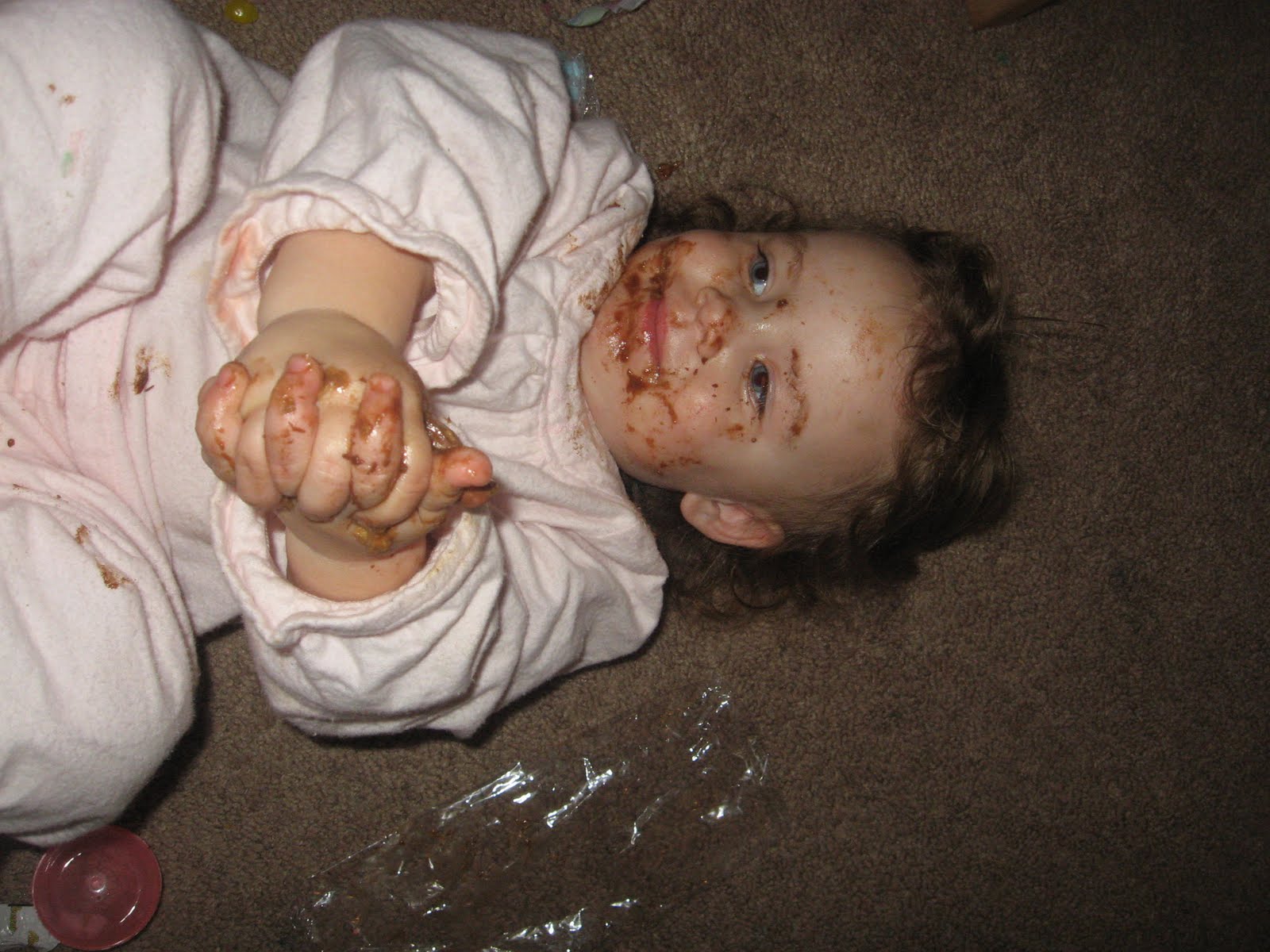
How to take pictures of a toddler...

Book of Mormon stories that my teacher tells to me...
Are about the Lamanites in ancient history...
Long ago their fathers came from far across the sea...
Given this land, if they live...
Righteously!
The wise man and the foolish man work as well.  Here we are building our house upon the rock.

Sunday, April 4, 2010

Easter!!

We had a wonderful easter, with good food, family, and naturally plenty of chocolate.
Myra started the morning off with bacon.
And it just got better from there...
Logan double fisted the lollipops.
But they shared with Pappy!